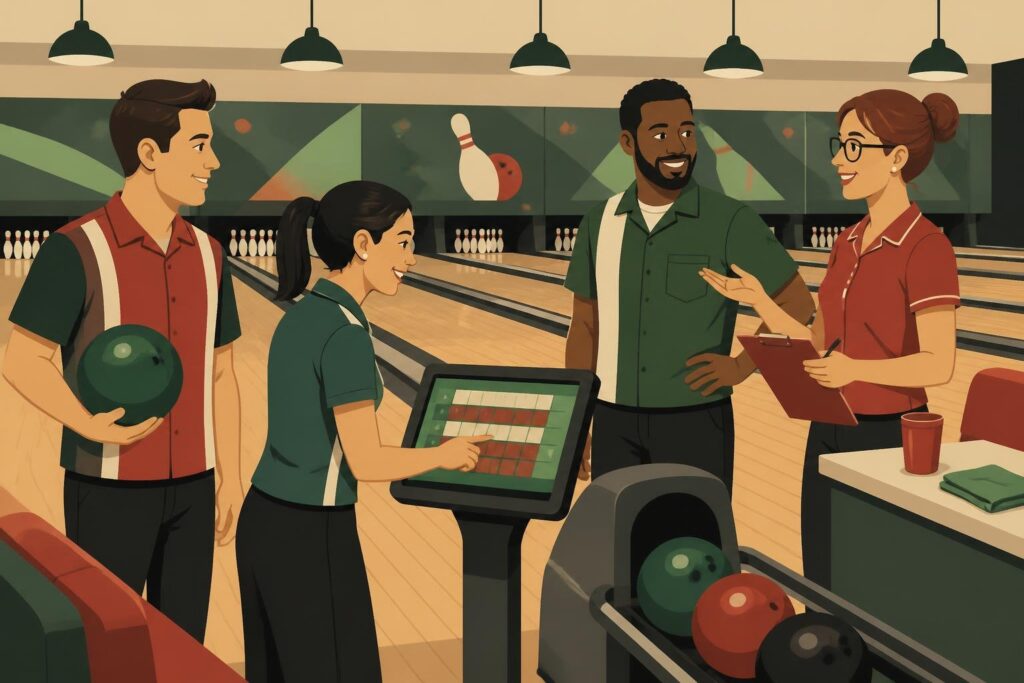
You show up for league night, and suddenly everybody sounds like they has a private shorthand. Someone asks for the average sheet. Another person mentions handicap. A teammate says the anchor is closing tonight, and the league secretary reminds everyone that point night starts next week. If you are new, it can feel like you missed a meeting.
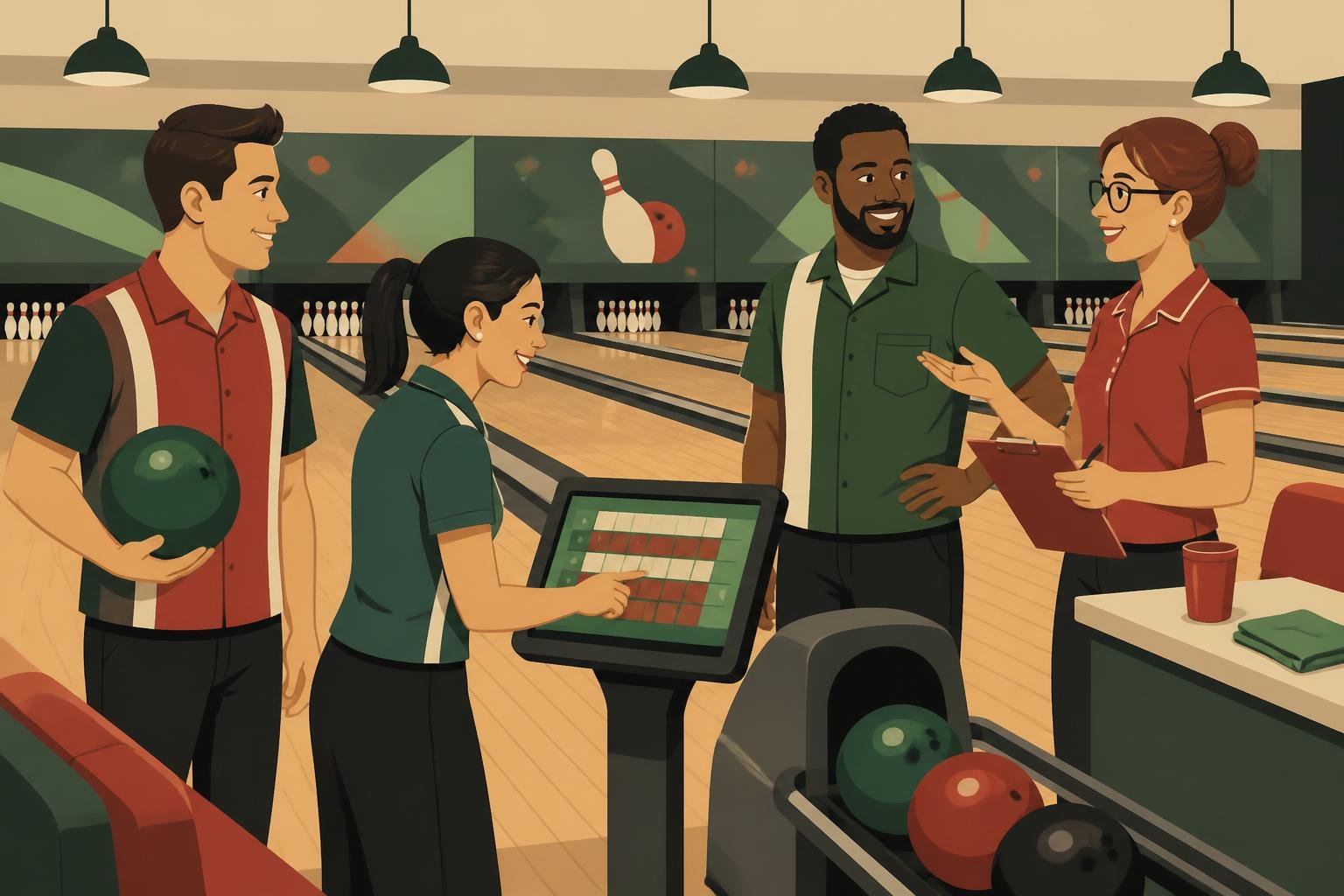
What is happening is actually pretty orderly. Bowling leagues run on a weekly rhythm, and once you understand that rhythm, the whole night stops feeling mysterious. You do not need to know every rule on day one. You just need a clear picture of what a league is, what happens when you arrive, how the scoring works, and what everyone means when they start talking about averages, points, and lineups.
This guide walks you through how bowling leagues work from the first night to the end of the season. You will see what a league really is, what your first night looks like, how scoring and handicap work, what team roles and substitutes do, how standings are built, and what to ask before you join. If you are new, casual, or just thinking about trying a league for the first time, the goal is to help you walk in knowing what to expect.
What a bowling league really is, in plain English
At the simplest level, a bowling league is a recurring competition that meets on a set schedule, usually once a week, for a fixed number of weeks. You bowl with the same team, against assigned opponents, under a shared set of rules. Over time, the league keeps track of scores, averages, points, and standings. That is what makes it different from just bowling with friends for fun.
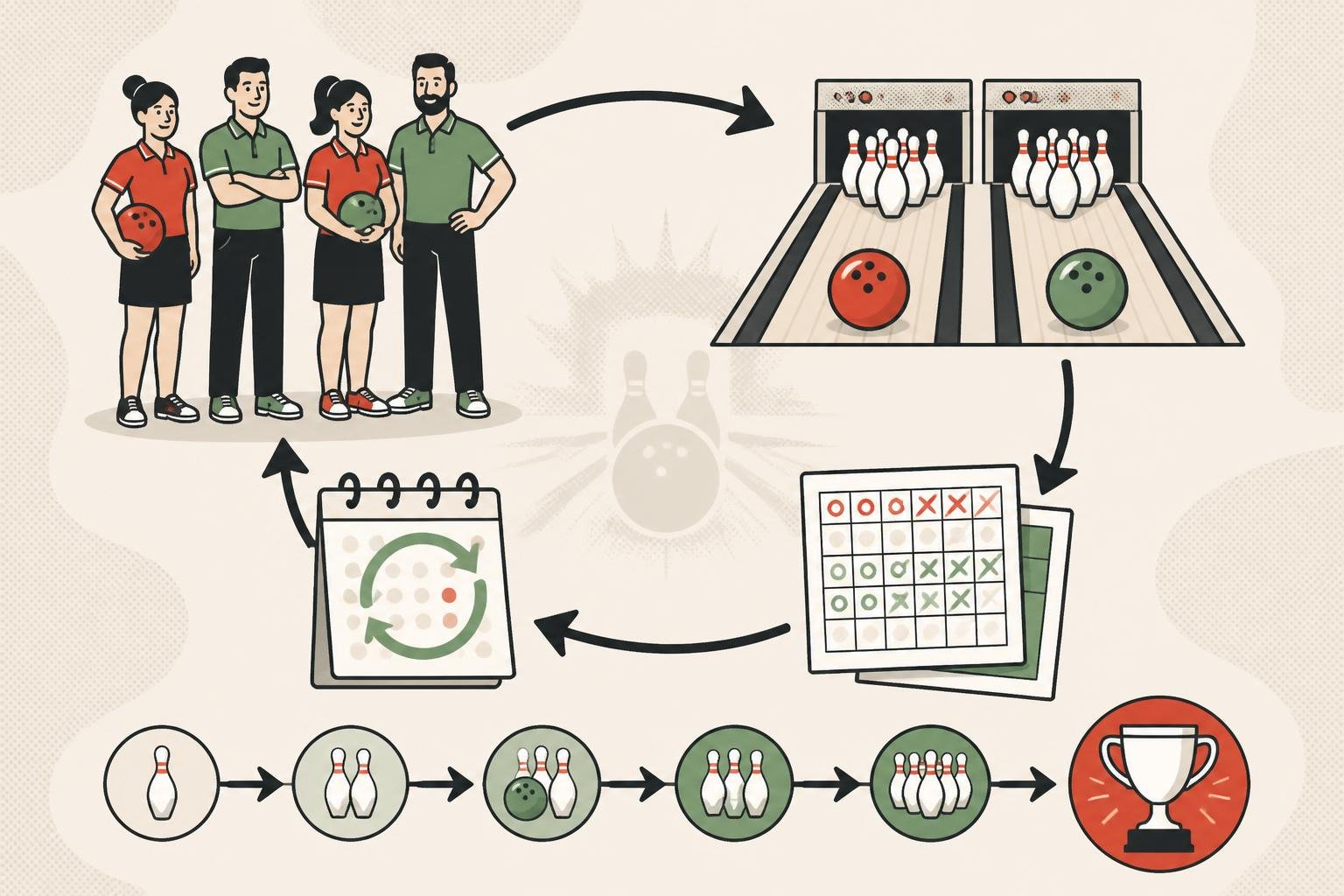
The structure matters because it changes the feel of the night. If you go to the lanes with a few friends and keep score on the screen, you are bowling socially. If you join a league, you are still bowling socially, but now there is a season behind it. You have a roster, a lineup, dues to cover league costs, and results that matter to the group as a whole. The setting can still be relaxed, especially in a casual or handicap league, but there is a framework underneath the conversation and the laughs.
Leagues come in a lot of flavors. Some are friendly and social, some are serious and competitive, some use handicap so bowlers of different skill levels can compete more evenly, and some are scratch leagues where raw pinfall decides everything. There are adult leagues, youth leagues, adult/youth combinations, family leagues, sport leagues, and leagues built around a particular pace or skill level. The important thing is that the league type changes the feel of the night, the way scores are compared, and what kind of bowlers the league is meant for. The United States Bowling Congress keeps an overview of common league options and certified league details on its league options page and league details page.
If you are wondering whether a league is the same thing as a tournament, the answer is no. A tournament is usually shorter and more self-contained. You enter, bowl in a set format, and the event ends. A league is seasonal. You keep coming back, usually with the same team and the same night of the week, and the season builds over time. That weekly repetition is the point. You are not just bowling a few games, you are taking part in a running competition.
And no, you do not need to be great to join. That is one of the biggest misconceptions new bowlers carry around. Many leagues are built so bowlers of different averages can participate without feeling like the night is only for the already skilled. Some leagues are meant for that exact middle ground, the rusty bowler, the beginner, the person who wants a regular night out with a little competition mixed in, or the experienced bowler who still wants a social setting.
The basic league building blocks
Most leagues are built around a handful of repeating parts: teams, roster sizes, weekly matchups, and a set number of weeks. The exact setup can vary, but the pattern is usually easy to follow once you see it in one place.
A team is the group you bowl with each week. Some leagues use three-person teams, some use four-person teams, and some use other formats. In a three-person league, you might have the same three bowlers every week unless someone needs a substitute. In a four-person league, the roster gives the league more flexibility if one person is out, and it also spreads the weekly load a little differently.
The reason the same people show up each week is simple: the season depends on it. League standings are built over the course of the schedule, so weekly attendance matters. You are not just dropping in for a casual night. Your presence, and your score, become part of the team’s record.
If a league is certified, that means it follows recognized rules for scores, averages, and awards. Certification matters because it helps keep things consistent, especially when averages are used for handicap, records, awards, or qualification. In practical terms, certification gives the league a rule framework so everyone is playing by the same book. For a new bowler, the important part is not the paperwork itself. The important part is that certified leagues use recognized standards, which helps make your scores and averages meaningful beyond your own team. The USBC explains certified league basics on its join now and league information page.
The main types of leagues you will actually run into
Once you start looking around, the word “league” covers more ground than you might expect. A few common types show up again and again, and understanding the difference makes it much easier to choose a league that fits you.
Fun or social leagues are usually the easiest for beginners to understand. The night is still competitive, but the tone is relaxed. People care about their scores, yet they also care about seeing each other every week, talking between games, and keeping the atmosphere comfortable. If you are looking for a league that feels close to a weekly outing with structure attached, this is often where you start.
Handicap leagues are built to make competition more even across different averages. They are common because they let more people contribute to the team outcome, even if one bowler averages much higher than another. If you are new, rusty, or still improving, this format often feels fairer than straight scratch competition.
Scratch leagues keep things simple. No handicap is added. Your score is your score. These leagues appeal to bowlers who want raw pinfall to decide the outcome and who are comfortable with a more demanding, less forgiving format.
Sport leagues usually use harder lane conditions and are designed to challenge the bowler more directly. They tend to attract players who want a tougher test and are willing to make adjustments as the lane changes from shot to shot.
Adult leagues, youth leagues, and adult/youth or family leagues are all built for different groups. The format changes the pace, the rules, and the atmosphere. A family league, for example, may be a better fit if you are bringing kids or introducing a spouse to bowling. A youth league may emphasize coaching, consistency, and age-appropriate competition. An adult league may be the most common evening league format at a center.
The type of league affects more than the label on the flyer. It changes lineup strategy, scoring expectations, and how much pressure the average bowler feels on a week-to-week basis. If you are not sure which one fits, it usually helps to ask what the league is trying to be. A league that is meant for strong competitive bowlers will feel very different from one that is meant for newer players who want to learn in a friendly setting.
What to expect on your first league night
The first night is often the hardest part, not because bowling itself is confusing, but because you are learning a new routine. Once the routine makes sense, league nights become much easier to navigate. Most weeks follow the same basic pattern: arrive, check in, warm up, bowl, verify scores, and leave with a better idea of where your team stands.

If you want the shortest possible version, here it is: show up early, find your team, listen for announcements, confirm the lineup, warm up, bowl your games in order, watch the score sheet or monitor, and make sure the final result is correct before you leave. That is the core of league night. Everything else hangs off that structure.
Arriving early is not a courtesy, it is a real advantage
You usually want to arrive early enough to check in without rushing. In many leagues, bowlers show up 15 to 30 minutes before start time, sometimes earlier if they need to pay dues, get lane assignments, or settle any lineup questions. If you are new, early is better than on time. That gives you a few minutes to find your team, get your shoes on, confirm who is bowling, and hear any announcements from the league secretary or lane supervisor.
League nights tend to move on a schedule. If you are still getting your ball out of the car while everyone else is listening to the secretary, you are already behind. That does not make you a problem, but it does make the first few minutes more stressful than they need to be. Arriving early gives you a chance to breathe, which matters more than people think when you are stepping into a new bowling environment.
Check-in, announcements, and the first few minutes
At check-in, you may hear about lane assignments, roster changes, absent bowlers, or local rule reminders. Sometimes it is very simple. Other nights there is more to absorb, especially if someone is subbing in or if a team needs to make a lineup change.
This is also where terms start showing up quickly. Someone may mention a vacancy, a blind score, or a point night. Those words are not meant to confuse you. They are just league language for common situations. A vacancy score is the score that counts when a spot on the roster is empty. A blind score is similar in practice, meaning the team is bowling without a live bowler in that lineup spot for the night. A point night is a night when the league awards points for head-to-head games, series, or other categories based on the league format. The exact details vary, but the idea is straightforward: a point night is a scoring night where more than just raw pinfall may matter.
You do not need to memorize every word immediately. It helps to hear them in context and then ask questions if needed. Most league bowlers are used to explaining the basics to someone new, and the simplest questions are often the most useful. “How does this league handle absent bowlers?” is a perfectly normal thing to ask.
Warmup, and why it matters more than it looks
Warmup usually comes right before bowling starts. You may get a few practice balls on each lane. That is not just a courtesy. It helps you figure out how the lane feels that night. Maybe the oil is a little farther down the lane than last week. Maybe the left lane is hooking earlier than the right. Maybe your ball is reading sooner than it did in practice. You do not need to solve all of that in warmup, but you do want to make a few good shots and settle in.
Warmup is also a chance to notice the little things that tell you how the night may go. If the ball is skidding too long, you may need to adjust your target or speed later. If the ball is checking early, you may need to move or soften something in your release. If all of that sounds technical, do not worry. The basic point is that warmup gives you the first clues. League bowlers use those clues to make decisions before the games start counting.
Courtesy matters here. If the person next to you is on their approach, you wait. If your lane pair is running on time, you keep your pace steady. League bowlers often care a lot about flow because the whole group is trying to finish at a predictable time. That is one reason you hear experienced bowlers talk about timing and lane courtesy so much. They are not being fussy. They are trying to keep the night moving for everyone.
What the first game usually feels like
The first game of the night often tells you more about the lane than your score does. Early frames can feel a little awkward while you find your timing. That is normal, especially if you have not bowled under league pressure before. People often want their first game to prove something. In reality, it usually serves as a read on the conditions, the pace, and your own nerves.
If you start with a couple of open frames, do not assume the night is ruined. Plenty of league bowlers leave the first game behind and bowl better in the second or third once they settle in. That is part of the rhythm of the sport. You are learning the lane as you go. Good bowlers do that too, they just tend to make the adjustments a little sooner and a little cleaner.
It also helps to remember that league nights are not judged on one shot. Yes, every frame matters. No, one bad opener does not make you a bad league bowler. The season gives you room to adjust, and most teams understand that first-night nerves are real.
How lineups and pairings usually work
Once the league starts, teams bowl in a set order. Your lineup is the order in which team members throw their shots. In many leagues, the order stays the same from week to week unless there is a reason to change it. A captain or team representative may set the lineup, or the team may decide it together.
On a four-person team, the order might look something like this: the first bowler is a steady starter who helps the team get on the board, the second bowler is often a reliable spare shooter, the third bowler may be the one who strings strikes together, and the anchor is the person finishing the game under pressure. That does not mean the anchor has to be the most talented bowler on the team in every sense. It means the anchor bowls last, so that person often gets the final word when a game is close.
On a three-person team, the roles may be less formal, but the logic is the same. You still have people who open the game, people who stabilize it, and someone who bowls later in the frame order. If you have ever wondered why a team might put a certain bowler last, that is usually why. The final position can matter when games are tight and pins are coming down to the last frame or two.
Pairings are the teams you bowl against that week. In some leagues, you always bowl head-to-head against one other team. In others, points may be spread across several categories, so your team can win part of the night even if you do not sweep everything. The league sheet or rule sheet tells you how the night is structured. That document is worth reading, because it explains the format in plain detail and usually answers the exact question you were about to ask anyway.
What happens after the last frame
When the games are done, you are not necessarily finished the second the last ball rolls. Teams usually verify the score, confirm any corrections, and make sure the result is recorded properly. That may sound dull, but it matters. A score mistake caught before people leave is easy to fix. A score mistake noticed the next day can become a headache.
Depending on the league, there may be quick post-game conversation, a check of standings, or a reminder about the next week. Some leagues are very social after bowling. Others finish, shake hands, and head out. Both are fine. The important thing is that the night does not end in confusion. You want to know whether the team result is settled and whether anything needs attention before the next session.
How league scoring works, including handicap
This is the part that tends to confuse new bowlers the most, and for good reason. Bowling scoring has a few layers, and once handicap enters the picture, people sometimes assume the whole thing is designed to make life complicated. It is not. Handicap exists to make competition fairer when bowlers with different averages share the same league.
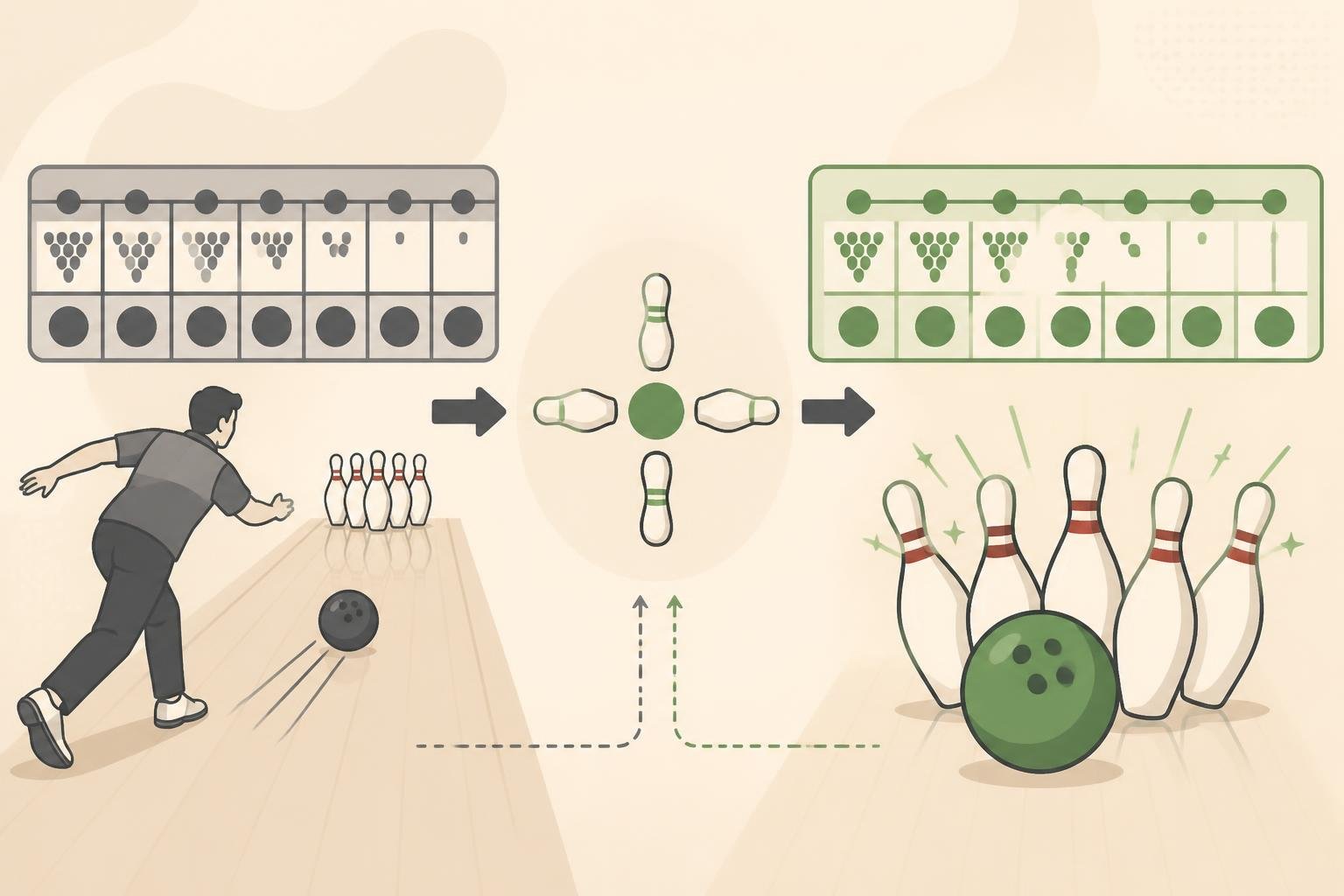
The USBC’s league rules page and its playing rules PDF explain the framework certified leagues use, but you do not need to memorize all of that to understand the basics. Start with the simple idea: you bowl games, those games make a series, your scores contribute to your average, and handicap may add extra pins to help lower-average bowlers compete more evenly. The formula itself can vary by league, so the league sheet is always the final word.
Pinfall, games, and series
Pinfall is the total number of pins you knock down. A game is one complete score from the first frame through the tenth frame. In most standard league settings, you bowl three games, and those three games combined make your series.
If you bowl 168, 174, and 161, your series is 503. That series total matters because it tells the league how you performed across the whole night, not just in one hot or cold game. A single good game can help, of course, but league scoring is usually more about consistency over time than about one lucky break.
That long view is one reason bowling leagues can be satisfying. You are not judged only on a single evening. The season gives you room to improve, adjust, and settle into a rhythm. The number from this week gets added to the numbers from last week, and that running record becomes your bowling story for the season.
Average, and why it matters so much
Your average is the foundation for a lot of league math. It is usually calculated from your total pins divided by the number of games you have bowled in the league. If you bowl 600 pins over three games, your average for that night is 200. Over a season, though, your average is tracked across all league games you bowl, so the number can move up or down as the season goes on.
Here is a simple example. Suppose you begin the season averaging 145. A few weeks later, after a better stretch of games, you are averaging 152. That change affects more than just bragging rights. It may change your handicap, your team’s expected scoring, and sometimes the way your team is lined up. In some leagues, a rapidly changing average can even influence handicap adjustments as the season progresses.
That is why people talk about averages so much. They are not just being technical. The average is the number that quietly drives a lot of the league system. If you are new, it is useful to know your current average, but you do not need to obsess over it every frame. Think of it as the season’s running summary of how you are bowling.
Handicap explained without jargon
Handicap is a scoring adjustment intended to help bowlers of different skill levels compete in the same league. The basic idea is simple: the league sets a target number, then gives lower-average bowlers extra pins based on the difference between their average and that target. Exact formulas vary by league rulebook, so the specific percentage or target score will depend on your league.
Here is a simple example without locking into one league’s formula. Imagine a league uses a target of 200. A bowler averaging 170 is 30 pins below that target. Depending on the league formula, that bowler may get some of those 30 pins added as handicap each game. If another bowler averages 200 or above, that bowler may get little or no handicap. The goal is not to punish the better bowler. The goal is to let both bowlers compete on the same night without the lower-average bowler feeling like the match is decided before the first ball is rolled.
That is why a lower-average team can sometimes win on paper even if the other team rolled more raw strikes. Handicap can change the outcome of a matchup. To someone new, that can feel strange at first. After a few weeks, though, it usually makes perfect sense. Without handicap, many casual leagues would simply be won by the highest-average bowlers every time, and that gets old fast for everyone else.
One useful way to think about handicap is this: it is not a shortcut and it is not charity. It is a scoring tool built to make a mixed-ability league competitive from top to bottom.
Scratch leagues versus handicap leagues
Scratch leagues keep things simple. Your score is your score. No added pins, no adjustment, no extra math to level the playing field. The highest pinfall wins.
That makes scratch leagues attractive to strong bowlers, serious competitors, and players who want every game decided purely by what they put on the board. It also means the gap between a 210-average bowler and a 150-average bowler will be hard to overcome unless the lower-average bowler is improving quickly. That is why scratch leagues tend to be more competitive and, in many cases, less beginner-friendly.
Handicap leagues are much more common for everyday league bowling because they let more people stay in the mix. A newer bowler can have a reasonable shot at contributing to team wins, even while still building consistency. If you are not sure which is right for you, a handicap league is usually the safer choice. It gives you room to grow without making every week feel like uphill work.
A full example of how a league match can score
Let us make this practical. Suppose Team A and Team B bowl against each other in a handicap league. Each team has three bowlers, and the league gives handicap based on average. The exact numbers depend on the league, so this is just an example of the process.
Team A bowls 640 scratch as a team. Team B bowls 610 scratch as a team. On raw pinfall, Team A is ahead by 30 pins. But if Team B gets 45 handicap pins and Team A gets 20, then the adjusted totals become 660 for Team A and 655 for Team B. Now Team B wins on handicap-adjusted score, even though Team A rolled more actual pins. That is the part that confuses new bowlers the first time they see it.
In many leagues, that one matchup may award points in several ways. A team might earn one point for each game won, plus points for total series, or some other split defined by the league. So you are not only trying to beat the other team’s raw score. You are trying to win the categories that matter in that league.
That is why the league sheet is so important. Two leagues can both say “handicap” and still use different formulas, different point structures, and different ways of handling ties. If you know only one thing about league scoring, let it be this: the local rules matter more than your assumptions.
Why scoring sheets, averages, and verification matter
League scoring is not just about the screen at the end of the lane. The official league sheet, score records, and average reports are what keep the season straight. That means you should pay attention when scores are posted and make sure the numbers match what you expected. Mistakes happen. Pins can be entered wrong, lineups can be off, and a score correction is much easier before everyone leaves.
Some leagues use the electronic scoring system and then print or circulate summary sheets. Others keep standings updated with a league secretary. Either way, the goal is the same: preserve a clean season record. If you see something strange, ask about it right away. Most issues are straightforward once someone actually looks at them.
Teams, subs, averages, and the people around you
Bowling leagues are about scores, but they are also about people. Teams need a little structure to function smoothly, and part of understanding how bowling leagues work is understanding the roster side of the night. Who is on the team, who can fill in, what happens when someone misses, and whether you can join without already having a group all matter more than most first-time bowlers realize.
The reassuring part is that leagues are used to this. People get sick, families have conflicts, work runs late, and life happens. Good leagues have ways to handle that, so one missed week does not break the entire season.
Joining as a full team, partial team, or solo bowler
If you already have a full team, joining is easy in the practical sense. You sign up together, you bowl together, and the league puts you on the schedule as a unit. That is the smoothest route if you know the people you want to bowl with.
If you only have part of a team, that can still work. Leagues often welcome partial groups and can fill the remaining spots with other bowlers looking for a home. That is especially common in social leagues and handicap leagues, where the atmosphere is often more open and flexible than newcomers expect.
If you are joining alone, do not assume that makes you an odd fit. It is very common. Many leagues need individual bowlers to fill open roster spots. You may get placed on a team with people you do not know yet, which can feel awkward for about the first ten minutes and then usually turns out fine. Bowling has a way of creating quick, low-pressure conversation. You can talk about equipment, lane conditions, scores, or nothing at all and still fit in.
Being solo can also be a good way to ease into the sport. You do not have to assemble the perfect group before you start. Sometimes the simplest path is just to sign up and let the league place you where you fit.
Captains, secretaries, and who does what
Most leagues have a few people who keep the night organized. The team captain is usually the person who communicates with the league, makes sure the roster is in order, and helps with lineup decisions. The league secretary keeps records, handles standings, and often serves as the point person for rule questions or score corrections. A lane supervisor or center staff member may handle the facility side of things, such as pairings, lanes, and equipment issues.
If you are new, you do not need to master all of those roles on night one. It is enough to know who to ask when you have a question. If you need to know your team’s lineup, ask the captain. If the league sheet looks wrong, ask the secretary. If a lane is malfunctioning, let the center staff know. Bowling nights run more smoothly when people use the right lane of communication, so to speak.
Subs, fill-ins, absentee scores, blind scores, and vacancy scores
A sub is a substitute bowler, someone who bowls in place of a regular team member who is absent. A fill-in is basically the same idea, though some leagues use the terms a little differently. The exact rules can vary, so always check the league sheet.

When a regular bowler misses a week, the league needs to know how to score that absence. Some leagues use an absentee score, which is a predetermined score assigned according to the league rules. Others may allow the team to use a sub’s actual score, or they may have a different formula for vacancy or blind scores. These terms sound formal, but the idea is simple: the league needs a fair way to account for the missing score so the standings stay workable.
A vacancy score or blind score is what the team gets when the roster spot is empty for the night and no substitute fills it. Some leagues use a fixed number, some use a percentage of team average, and some have other procedures entirely. That is why you should never assume every league handles absences the same way. A rule that seems obvious in one league may be handled differently in another.
For a new bowler, the important part is not the technical label. It is knowing that if you miss a week, you should tell someone as early as possible and ask how your league handles absences. Do not assume it will be the same everywhere. One league might have a straightforward absentee rule, while another uses a different method for lineups and score replacement.
If you are the substitute, show up ready. A good sub is reliable, understands the pace, and knows that the team you are helping may be depending on your score to stay competitive that night. That does not mean you need to play hero. It means you should take the night seriously and avoid treating the sub spot like an afterthought.
What makes a league team work over a season
The teams that do well over a season usually share a few habits: they communicate, they show up on time, they keep the night calm, and they do not turn every rough frame into a group problem. That is true whether the team is trying to win the league or just trying to have a good weekly night out.
Reliability matters more than drama-free perfection. A team with average talent and good attendance often beats a team with great talent and frequent absences simply because the first group stays on the schedule. Bowling leagues reward consistency in more ways than one.
The social side matters too. You do not need to become best friends with everyone on your roster, but it helps if you can communicate clearly and keep the night easy to manage. If you know you will miss, say so. If you need a lineup change, mention it early. If you are bringing in a sub, make sure the team knows. Small communication habits save a lot of awkwardness.
League dues, prize funds, and where the money goes
New bowlers often look at the weekly fee and wonder why league bowling costs more than they expected. The answer is that you are usually paying for more than lane time. League dues often cover several parts of the night and the season, including the actual games you bowl, prize money, and sometimes additional league expenses.
Bowling centers and league organizers handle this a little differently, but most leagues separate the money into a few practical categories. The weekly amount may include the cost of the games you bowl, a prize fund contribution, and any league operating extras. Some leagues also require membership or sanctioning fees, especially if the league is certified. The USBC’s league information explains the general structure of league costs on its league details page.
What lineage means, and why you may hear that word
When bowlers talk about lineage, they mean the lane or game fee charged by the center for the games you bowl. It is one of the most common parts of the weekly cost. If you hear someone say, “The lineage went up this year,” they are talking about the cost of bowling itself, not the prize fund or sanctioning fee.
That matters because league dues are not just one pool of money. Some money pays the center for bowling. Some money goes to the prize fund. Some may cover awards, banquet costs, or league administration. If the league is certified, a portion may also go toward membership or sanctioning. You do not need to be an accountant to join a league, but you should know what the fee includes before you sign up.
The usual line items in a league fee
Most league dues are some combination of the following:
- Lane time or lineage, which covers the games you bowl at the center.
- Prize fund, which is set aside for end-of-season payouts, awards, or special prizes.
- Secretary or league expenses, which can include administrative costs or supplies.
- Membership or sanctioning fees, if the league is certified and requires them.
- Banquet or celebration costs, in leagues that put part of the money toward a season-ending event.
Not every league includes all of these items, and some organize them in a very transparent way. Others just give you one total weekly amount and explain what it covers. Either way, you should know where your money is going before you join. That is not being picky. It is normal due diligence.
It is also worth asking whether you still owe weekly dues if you miss a week. Many leagues do expect regular payment, since the season’s finances are built around a predictable roster. Again, the rule sheet matters. If you know you will miss a week or two during the season, that should be part of your questions before signing up.
When dues are collected and how the season budget works
Most leagues collect dues weekly, often before bowling starts or during check-in. Some leagues prefer one payment method, while others are flexible. The important part is that the league is usually working on a season budget. The money collected each week has to cover what the league owes the center, what it has set aside for prizes, and any administrative costs that have been approved by the league.
That is why league money is often handled carefully. It is not just a casual tip jar. The budget has to last all season, and the prize fund needs to be protected until the end. If a league looks unusually vague about money, ask questions. A good league should be able to explain the basics without making you feel like you are overthinking it.
What to ask before you join
A few practical questions can save you a lot of confusion later:
- What is the total weekly cost?
- How much of the fee goes to bowling, and how much goes to the prize fund?
- Are there any one-time membership or sanctioning fees?
- Do I still owe dues if I miss a week?
- How are end-of-season payouts handled?
- Is there a banquet, trophy night, or prize distribution event at the end of the season?
If the league representative answers clearly, that is a good sign. A well-run league should be able to explain its money without making you feel like you are bothering anyone. If nobody can tell you what the fees cover, that is worth paying attention to.
Rules, etiquette, and the small habits that make league night easier
You do not need to memorize a giant rulebook to survive league night, but you should know the behaviors that keep the night moving smoothly. Most of them are simple. The challenge is not that they are hard, it is that league bowlers expect them to happen automatically. Once you know the habits, though, they become second nature pretty quickly.
League play often follows local rules plus national standards when the league is certified. The USBC’s general bowling rules and welcome page is a useful starting point if you want the broad picture, but your local league sheet is the real guide for week-to-week procedures. That is the document that tells you how substitutions work, what happens for a no-show, and how a lineup change is handled.
The etiquette that matters most
League etiquette is mostly about respect for timing and space. A few habits matter more than the rest.
Be ready when it is your turn. If you are still chatting, tying shoes, or wandering off when your lane is up, the whole pair slows down. Watch lane courtesy. Do not step onto the approach while the bowler on the adjacent lane is delivering the ball. Keep noise reasonable. League nights are social, but the pair next to you still needs to hear themselves think. Stay in your frame order. If your team has a defined lineup, bowl in that order unless the league rules allow a change. Be mindful with equipment and belongings, because bags, drinks, and loose gear should stay out of the way.
One thing new bowlers sometimes miss is that league pace is not the same as open bowling pace. In open bowling, people drift a little. In league bowling, everyone is trying to finish a schedule and keep multiple teams moving at once. That makes the night feel more structured. It also means that someone standing around between shots can throw off the rhythm more than they might realize.
There is also an unwritten expectation that you use the same general approach on every shot. That does not mean you have to become robotic. It means league bowlers often value consistency: your pre-shot routine, your timing, and your concentration all matter because the night is a competition, not just recreation.
Common first-time mistakes that are easy to avoid
Most first-time league mistakes are not serious. They are just the sort of things that happen when you do not yet know the rhythm of the night.
One common mistake is arriving too close to start time and then feeling rushed while everyone else is already settled. Another is treating warmup like extra open bowling and taking too many shots too slowly. A third is talking through someone else’s approach without realizing how distracting it can be. New bowlers also sometimes forget to check the score after the game, which is how avoidable mistakes get carried into the next week.
The fix is simple: show up early, listen carefully, and ask one or two clarifying questions instead of trying to guess. People usually appreciate that. It shows you care enough to learn the format.
What the rule sheet usually covers
Every league should have a rule sheet or league sheet that lays out the local procedures. This is where the practical details live. Depending on the league, it may cover how many games are bowled each night, how match points are awarded, how handicap is calculated, how substitutes are used, what happens if someone is late or absent, how postponed nights are handled, and how lineup changes work.
If you have a question, the rule sheet is usually the first place to look. That is not just bureaucracy. It is how the league avoids arguments. The more clearly the procedures are written down, the less likely a random misunderstanding will turn into a problem on the lanes.
And if something does go wrong, most league bowlers would rather solve it calmly than make a scene. A quick question to the league secretary usually fixes more than you would expect.
How standings, point nights, playoffs, and season results are decided
Here is where the season starts to feel real. Weekly games matter, of course, but the league is not only about one night at a time. Over weeks and months, the league builds standings, totals, and sometimes playoff brackets or roll-offs. By the end of the season, there is usually a clear way to decide who finished where and how prizes or honors are handed out.
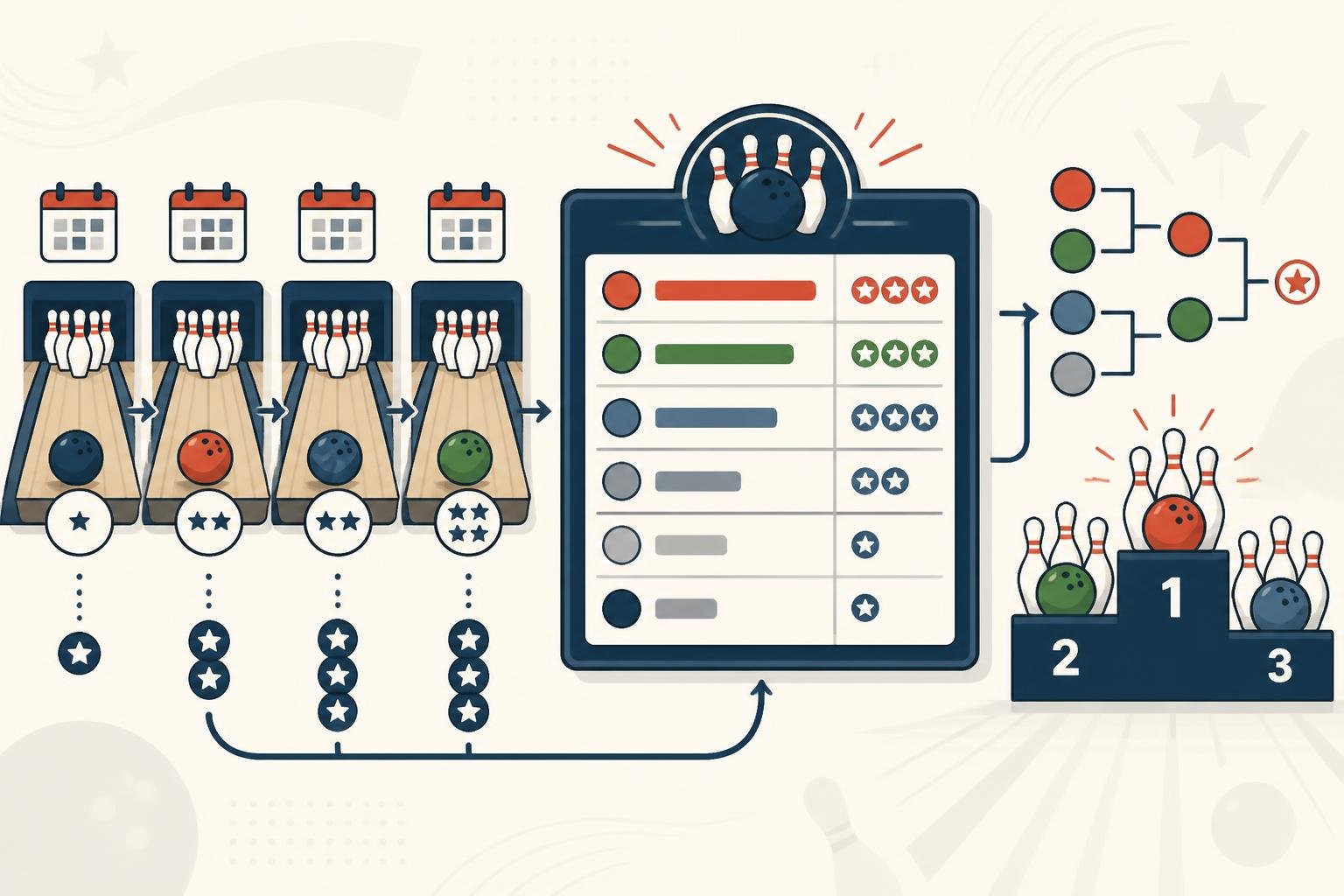
The exact format varies by league, which is why the schedule and rule sheet matter so much. Some leagues rank teams mainly by match points. Others weigh total pinfall heavily. Some use a combination. A few have a postseason series, while others finish based on regular-season totals only. The USBC’s league schedule information is a helpful reference point for how seasons are organized, even though your local rules may still differ in the details.
Match points versus total pinfall
The distinction between match points and total pinfall is one of the biggest things new league bowlers have to learn. Match points are awarded for winning a game, a series, or another scoring category defined by the league. Total pinfall is simply the total number of pins knocked down over the night or over the season.
Imagine Team A bowls 2,900 pins over a three-week stretch and Team B bowls 2,850. On raw pinfall, Team A is ahead. But if Team B wins more head-to-head games or earns more match points, Team B may sit higher in the standings. That is why you cannot look at one number alone and know who is “winning” the league.
Some leagues use both systems at once. That gives the league a more balanced way to reward performance. Total pinfall measures how much a team actually knocked down, while match points reflect whether the team beat the opponents on the lanes. If you are trying to understand your league standings, ask which number matters most. The answer is not always obvious from the scoreboard alone.
What point night means in everyday terms
When a league talks about a point night, it usually means that your weekly results are being translated into points that count toward the standings. For example, you may get points for winning Game 1, points for winning Game 2, points for winning Game 3, and points for winning total pinfall for the night. Another league may award points in a different split. The point is that the night’s result becomes more than a single game score.
Once you understand that, the phrase stops sounding mysterious. A point night is just a structured scoring night in which the league uses points to measure team performance across one or more categories. That system is popular because it gives teams more than one way to compete. You might lose the first game but still recover in the second and third. That keeps more teams in the running across the season.
Why averages matter late in the season
Your average can matter even more as the season goes on. If your average climbs, your handicap may change. That can affect your team’s weekly scoring. It can also affect future lineup decisions if the team is trying to balance scoring slots or keep a certain competitive shape.
Improvement is a good problem to have. If you are bowling better than you were in week one, that usually means your practice or adjustments are working. The only catch is that higher averages may reduce handicap in some leagues, which can make the standings feel tighter. That is normal. The league is supposed to reflect current performance, not freeze you at your first few weeks’ numbers forever.
Late-season lineup decisions can also get a little more strategic. Teams may start paying closer attention to who is finishing strong, who is steady on difficult lane conditions, and which order gives the best chance to earn points. This is where the anchor role becomes more visible. If games are close, the final bowler may be the one asked to settle the match.
End-of-season payouts, awards, and playoff formats
Many leagues end with some combination of payouts, prizes, trophies, plaques, or banquet recognition. The prize fund built from weekly dues usually supports that. Sometimes teams get a cash payout based on finish. Sometimes individual bowlers receive recognition for high game, high series, improvement, or other season accomplishments. Some leagues do both.
A season-ending event is common, though not universal. It may be a banquet, a prize night, or a simple award presentation at the lanes. The exact style depends on the league culture and budget. If this matters to you, ask about it before you sign up. A league with a strong end-of-season payout structure can feel different from one that is mostly about the weekly competition and a simple finish.
Some leagues also use playoffs or roll-offs. That means the regular season gets you to a final stage, and the top teams or bowlers compete again for the title. Other leagues finish entirely on regular-season standings. Neither setup is inherently better. A playoff format adds a little drama at the end. A straight standings format rewards steadiness all season long. The rule sheet will tell you which one you are joining.
How to choose the right league for you
If you are wondering how to choose, start with your own life, not with the league flyer. The best league for you is usually the one that fits your schedule, your comfort level, your budget, and your goals. A league can be perfectly well run and still be the wrong fit if the night is too late, the travel is too far, or the format is more serious than you want.
It helps to think about why you want to join. Are you looking for a regular night out? Do you want to get better under pressure? Do you want your family to bowl together? Are you hoping to make friends, compete harder, or get more consistent with your game? The answer will point you toward different kinds of bowling leagues.
A simple checklist before you sign up
Before you commit, ask about the basics. The day and time need to fit your schedule. The season length should be clear, so you know how many weeks you are signing up for. Team size matters, because you need to know whether you are joining a full roster or helping fill a spot. Cost matters too, including dues, sanctioning fees, and any extras. The format matters, especially whether it is handicap or scratch. Skill level matters, because you want to know whether the league is beginner-friendly or more competitive. Travel time matters as well, because a league can get old fast if the center is a chore to reach every week.
If a league can answer those questions clearly, that is usually a good sign. You are looking for fit, not perfection.
Good fits for beginners, families, and returning bowlers
If you are new to bowling, a handicap league is often the easiest entry point. It gives you a fairer shot against more experienced bowlers and takes some pressure off your score. A league with a friendly social reputation, a reasonable start time, and a forgiving pace is often the best place to begin.
If you are bringing family members, look for a family league, youth league, or an adult/youth format. Those leagues are usually built with more flexibility and a more welcoming atmosphere for mixed ages and mixed experience levels. They can be a good bridge between casual bowling and more regular league play.
If you used to bowl years ago and want to come back, you may want a league that is competitive enough to keep you engaged but not so demanding that it feels like a full-time project. Returning bowlers often do best when they choose a league that lets them rebuild rhythm without getting punished for rust.
If you are more serious, a scratch league or sport league may be the better match. Those leagues tend to reward stronger technique, better adjustment skills, and comfort with a tougher environment. They are a good fit when you are less interested in leveling the field and more interested in testing yourself honestly against the condition and the field.
Questions that tell you a lot about a league
Sometimes the best way to judge a league is not by reading the flyer, but by asking a few direct questions. How many teams are in the league? What happens if someone misses? Is the league usually full, or is it still building? How are standings tracked week to week? Is there a social element after bowling, or is everyone there mostly to compete and go home? Those answers tell you a lot about the night you are joining.
You can also ask whether the league tends to draw newer bowlers, established league bowlers, or a mix. That matters more than people realize. A league full of longtime competitors may have a faster pace and more specific expectations. A league with a lot of newer or returning bowlers may feel easier to settle into. Neither is wrong. You just want to know what kind of room you are walking into.
What to bring, what to expect, and how to avoid looking lost
You do not need to arrive with a giant bag of gear and a deep knowledge of bowling culture. But a little preparation helps a lot, especially the first few weeks. League night goes more smoothly when you show up with the basics handled.
House balls and rental shoes can absolutely work if that is what you have. You do not need a custom ball to join a league. That said, many bowlers eventually prefer their own ball because it fits their hand better and gives them more consistent reaction. If you are unsure whether to buy equipment yet, ask a pro shop or a coach, but do not let gear concerns stop you from joining. Plenty of people start with the simplest setup and grow from there.
What should be in your bag
For most bowlers, a practical league-night bag includes a few essentials.
Your bowling shoes matter if you own them, because comfort and fit matter more than people think. Your bowling ball matters if you have one, especially if it is drilled and fitted to your hand. A towel matters because you will want to wipe oil off the ball between shots. Tape or thumb inserts matter if you use them. Grip aid or rosin may matter if it is part of your routine and allowed by your league or center. Water and a snack matter more than new bowlers expect, especially if the night is long and you do not want to feel flat by the third game.
That is really the point of the bag. You are not trying to look like a pro. You are trying to remove small annoyances before they become distractions.
When each item actually matters
Not every item in your bag will matter every week, and that is fine. Shoes matter most if you bowl often enough that comfort and traction become noticeable. A towel matters most if your ball is picking up lane oil and changing reaction as the night goes on. Tape matters when your fit changes a little or your hand feels different from week to week. Water matters when the night is long, the building is warm, or your concentration starts dropping between games. The more you bowl, the more you will know which items are true essentials for you and which ones are just nice to have.
As for clothing, think comfort and mobility. You want to be able to move freely on the approach, and you do not want anything so loose or awkward that it gets in the way. If the league or center has any dress expectations, they will usually mention them beforehand, but most leagues are not trying to make you dress up. They just want you to bowl safely and comfortably.
Finally, do not be embarrassed if you do not know how to keep score perfectly or if you have not learned all the lane terms yet. You are not supposed to know everything on night one. Ask questions, keep track of your lineup, pay attention to the league sheet, and stay on time. That is enough to get started.
How the first weeks usually feel, and what changes by midseason
Knowing how bowling leagues work is one thing. Getting comfortable with the rhythm is another. The first few weeks of a season usually feel slightly clumsy because everyone is still adjusting, not just you. People are sorting out lineups, seeing how the lanes are playing, and remembering how the league handles small things like score changes or absences.
By the second or third week, the night starts to feel more familiar. You know where to check in. You know how much warmup you get. You know who handles the lineup. You have a better sense of whether the night is quick or slow, whether the center tends to oil the lanes a certain way, and how your own game tends to settle in over three games.
Midseason is where the league starts to feel like a real routine. Your average becomes more meaningful because there is enough data behind it. Teams begin to understand who is steady and who is streaky. Standings get a little more interesting because the results from earlier weeks start to matter. At that point, bowling league stops feeling like something you are figuring out and starts feeling like something you are part of.
That transition is one of the underrated benefits of league bowling. You do not just bowl more often, you learn more about your own game in a regular environment. You see how you respond to pressure, how you handle lane changes, and how your scores shift when you pay attention to the little adjustments.
So, how do bowling leagues work from first night to season’s end?
If you strip away all the terminology, the answer is pretty straightforward. You join a team, sign up for a weekly season, pay dues that help cover bowling and prizes, and compete under a set of rules and standings that stretch across the season. Each week you bowl your games, your scores contribute to your average, handicap may help level the competition, and your results feed into the league table. By the end of the season, the league uses those standings, points, or pinfall totals to determine winners, payouts, and awards.
The first night feels confusing because the system is new. After that, the routine starts to settle in. You learn where to stand, when to be ready, how your team lines up, and which parts of the scoring matter most. Before long, the language that sounded like code starts to feel normal.
That is really the best part of league bowling. It gives your bowling a home base. Instead of wondering when you will bowl next or who you will bowl with, you have a regular night, a regular group, and a season that builds one week at a time. Whether you are there for competition, camaraderie, or just a reliable reason to get out of the house, a league gives the sport a rhythm you can settle into.
If you are on the fence, the most useful next step is simple: look for a league that fits your schedule and ask for the rule sheet. Once you have that in hand, most of the mystery disappears.